

basic kettlebell exercises pdf
Unlock a powerful workout with our free PDF guide to basic kettlebell exercises! Build strength, endurance & get fit at home. Download now & start swinging!
Kettlebell training offers a dynamic, full-body workout, blending cardio and strength. Numerous resources, like those found on Pinterest, showcase beginner-friendly routines.
These exercises, often detailed in PDFs, emphasize core engagement and functional movement patterns. Explore variations for all fitness levels, starting with foundational techniques.
Discover how kettlebells can transform your fitness journey, providing efficient and effective results, as highlighted in online workout guides and visual demonstrations.
What are Kettlebells?
Kettlebells are cast iron or steel weights resembling a cannonball with a handle. Unlike traditional dumbbells, the offset center of gravity presents a unique challenge, demanding greater core stabilization and full-body engagement during exercises. This design fosters functional strength, mirroring real-life movements more effectively.
Numerous online resources, including Pinterest, offer downloadable PDFs detailing basic kettlebell exercises for beginners. These guides often illustrate proper form for swings, squats, and deadlifts – foundational movements crucial for building a solid base. The weight distribution necessitates controlled technique to prevent injury, making instruction vital.
Kettlebells aren’t just about brute strength; they enhance cardiovascular fitness, improve flexibility, and boost endurance. PDFs frequently categorize exercises by skill level, allowing individuals to progress safely. From simple swings to more complex movements, kettlebells provide a versatile tool for achieving diverse fitness goals. They are a compact and effective way to build strength and conditioning.
Benefits of Kettlebell Training
Kettlebell training delivers a multitude of benefits, extending far beyond traditional weightlifting. The dynamic nature of exercises, often outlined in basic kettlebell exercises PDFs found online, improves cardiovascular health, boosting endurance and calorie burn. Simultaneously, it builds strength and power throughout the entire body.
Unlike isolated machine exercises, kettlebells necessitate core engagement for stabilization, leading to improved posture and reduced risk of lower back pain. Pinterest resources showcase routines targeting abdominal muscles, enhancing core strength. These PDFs emphasize functional movements, translating to improved performance in everyday activities.
Furthermore, kettlebell training enhances flexibility, coordination, and balance. The unique offset weight challenges the body in new ways, promoting neuromuscular adaptation. Regularly utilizing downloadable PDFs ensures proper form and progressive overload, maximizing results and minimizing injury risk. It’s a time-efficient, full-body workout suitable for various fitness levels.
Basic Kettlebell Exercises for Beginners
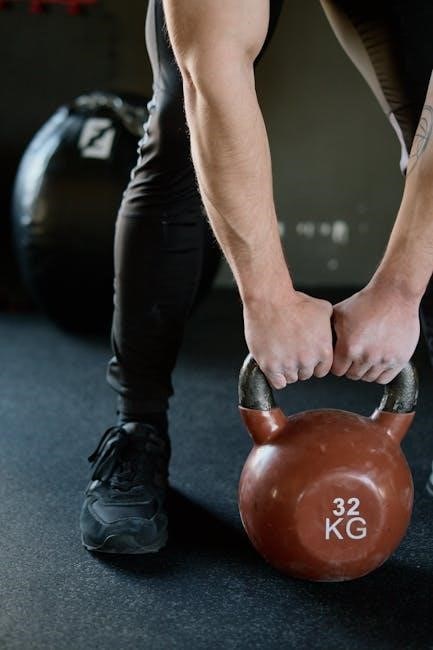
Beginner kettlebell exercises, often detailed in readily available PDF guides, focus on mastering fundamental movements. These build a solid foundation for progression.
Explore swings, squats, and deadlifts to establish proper form and technique, ensuring safe and effective workouts.
Kettlebell Swing
The Kettlebell Swing is a foundational exercise, often detailed in basic kettlebell exercises PDF guides, renowned for its full-body engagement and cardiovascular benefits. It’s crucial to master the hip hinge movement – think of hiking a football – to power the swing, not rounding your back.
Begin with a lighter kettlebell to focus on form. Stand with feet shoulder-width apart, kettlebell slightly in front of you. Hike the kettlebell back between your legs, then explosively drive your hips forward, propelling the kettlebell to chest height. Maintain a neutral spine throughout the movement.
Avoid using your arms to lift the kettlebell; the power comes from your hips and glutes. As the kettlebell descends, guide it back between your legs, maintaining core engagement. Focus on controlled movements and a powerful hip extension. Many online resources offer visual demonstrations to aid in proper technique, ensuring a safe and effective workout.
Goblet Squat
The Goblet Squat, frequently featured in basic kettlebell exercises PDF resources, is an excellent variation for beginners learning proper squat form. Holding the kettlebell close to your chest – like a goblet – encourages a more upright torso and deeper squat depth.
Stand with feet slightly wider than shoulder-width apart, toes pointed slightly outward. Hold the kettlebell vertically against your chest, elbows pointing down. Initiate the squat by pushing your hips back and bending your knees, keeping your back straight and core engaged.
Descend until your thighs are parallel to the ground or as low as comfortably possible. Drive through your heels to return to the starting position. The kettlebell’s position acts as a counterbalance, promoting better posture and stability. Online guides often emphasize maintaining a neutral spine and avoiding knee valgus (knees caving inward).
Kettlebell Deadlift
The Kettlebell Deadlift, a cornerstone of many basic kettlebell exercises PDF guides, builds posterior chain strength – targeting the glutes, hamstrings, and lower back. Unlike a traditional barbell deadlift, the kettlebell’s offset center of gravity demands greater core stabilization.
Stand with feet shoulder-width apart, kettlebell positioned slightly in front of you. Hinge at the hips, keeping your back straight and core braced, and grasp the kettlebell with both hands. Maintain a neutral spine throughout the movement.
Drive through your heels, extending your hips and knees simultaneously to lift the kettlebell. Avoid rounding your back. Lower the kettlebell back to the ground with control, maintaining the hip hinge. Many resources highlight the importance of keeping the kettlebell close to the body for optimal leverage and safety.
Kettlebell Turkish Get-Up (Beginner Modification)
The Turkish Get-Up, often found in basic kettlebell exercises PDFs, is a complex, full-body movement. A beginner modification simplifies this exercise, focusing on building foundational strength and coordination. Start lying on your back with knees bent and feet flat, holding the kettlebell extended towards the ceiling with one arm.
Roll onto your opposite elbow, maintaining the kettlebell’s position. Push up onto your hand, then bridge your hips off the ground. Step one leg forward, and then the other, transitioning into a lunge position. Maintain a stable core and controlled movements throughout.
Lower back down in reverse, reversing each step. Focus on controlled transitions and maintaining the kettlebell’s stability overhead. This modified version builds the necessary strength for the full Turkish Get-Up.
Kettlebell Exercises for Core Strength
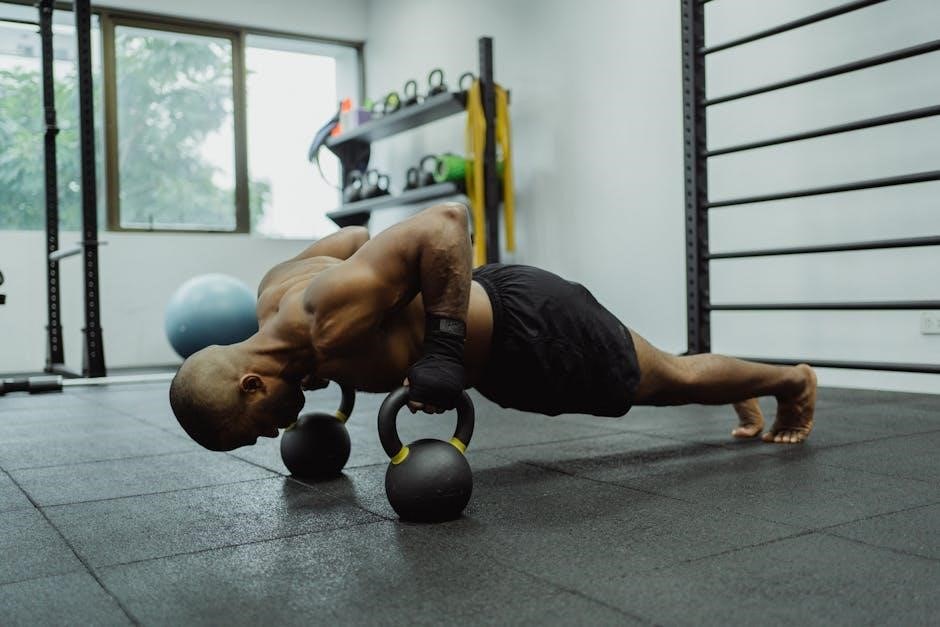
Kettlebell workouts, detailed in basic kettlebell exercises PDFs, powerfully engage the core. Exercises like twists and windmills enhance stability and rotational power.
Strengthen your midsection with dynamic movements, improving posture and overall functional fitness.
Kettlebell Russian Twist
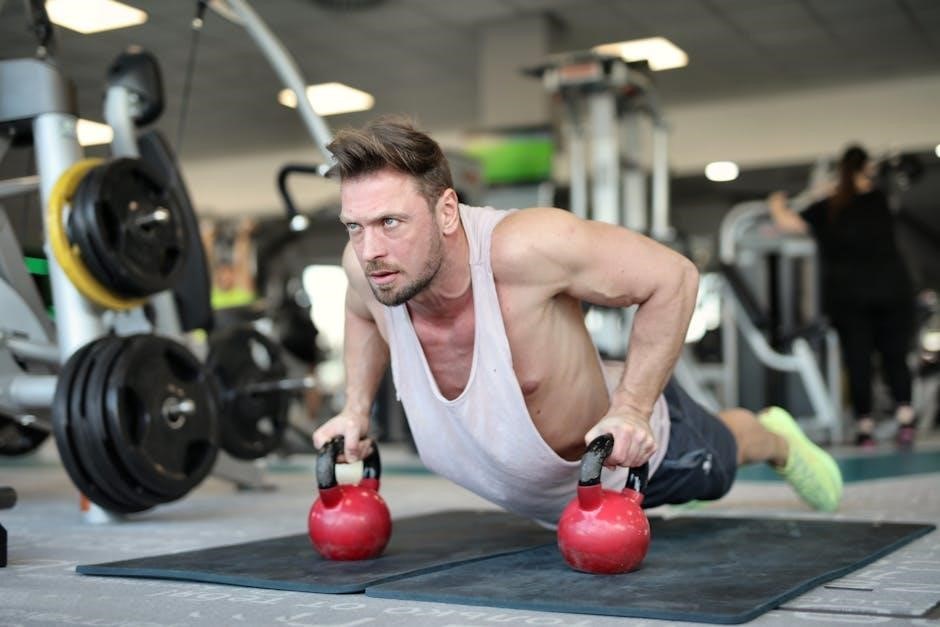
The Kettlebell Russian Twist is a fantastic core exercise often found in basic kettlebell exercises PDF guides, targeting the obliques and rotational strength. To perform, sit on the floor with your knees bent and feet slightly elevated – beginners can keep feet grounded for stability.
Hold a kettlebell (start with a lighter weight) close to your chest. Lean back slightly, maintaining a straight spine, and twist your torso from side to side, tapping the kettlebell towards the floor on each side.
Focus on controlled movements, engaging your core throughout the exercise. Avoid using momentum; the power should come from your abdominal muscles. This exercise builds rotational power crucial for many athletic movements and everyday activities.
Progress by increasing the weight of the kettlebell or lifting your feet higher off the ground. Remember to maintain proper form to prevent lower back strain. Many online resources demonstrate correct technique.
Kettlebell Windmill
The Kettlebell Windmill, frequently detailed in basic kettlebell exercises PDF resources, is a challenging yet rewarding exercise that builds core stability, flexibility, and strength. Begin standing with feet wider than shoulder-width apart, holding a kettlebell overhead with one arm.
Keep your arm locked out and gaze fixed on the kettlebell throughout the movement. Hinge at the hips, bending to one side while keeping your back straight and the kettlebell directly over your shoulder. The opposite arm extends straight out to the side for balance.
Lower yourself until you feel a stretch in your hamstrings, then return to the starting position. This exercise demands significant core control and shoulder stability. Start with a light weight and focus on maintaining proper form to avoid injury.
It’s crucial to keep your eyes on the kettlebell and maintain a straight back throughout the entire range of motion.
Kettlebell Plank Drag
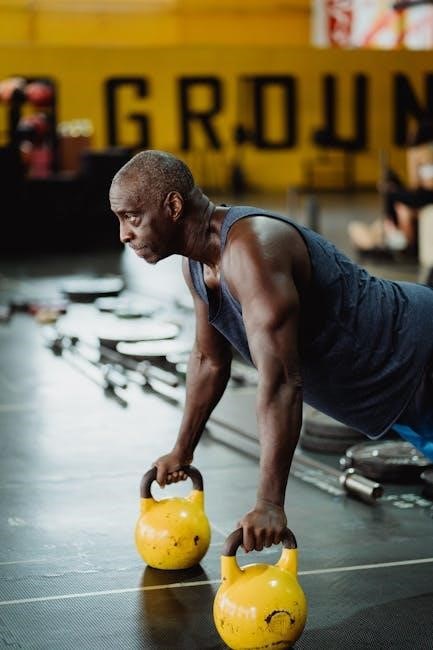
The Kettlebell Plank Drag, often illustrated in basic kettlebell exercises PDF guides, is an excellent exercise for enhancing core strength, stability, and anti-rotation. Begin in a high plank position with a kettlebell positioned just outside one hand.
Maintaining a rigid plank – avoiding hip rotation or sagging – use the hand to drag the kettlebell across the body to the other side. Repeat, alternating sides with each repetition. Focus on keeping your core engaged and your body in a straight line from head to heels.

This exercise challenges your obliques and transverse abdominis, promoting a strong and stable core. Start with a lighter kettlebell to master the form before increasing the weight.
Proper form is paramount; prioritize control over speed to maximize effectiveness and minimize the risk of injury. It’s a fantastic addition to any core-focused routine.
Intermediate Kettlebell Exercises
Progressing from basic movements, intermediate exercises build upon foundational strength. PDF guides detail techniques like cleans, snatches, and figure eights.
These drills demand greater coordination, power, and control, enhancing overall fitness.
Kettlebell Clean and Press
The Kettlebell Clean and Press is a powerful, full-body exercise that builds strength, coordination, and endurance. It combines the explosive power of a clean with the overhead stability of a press, making it a fantastic progression from basic kettlebell movements.
Starting Position: Begin with the kettlebell positioned slightly in front of you. Hinge at the hips, keeping your back straight, and grip the kettlebell.
The Clean: Drive through your legs, extending your hips and knees to pull the kettlebell upwards. As the kettlebell reaches chest height, quickly drop under it, catching it in a front rack position – elbow tucked in, kettlebell resting on your forearms.
The Press: From the front rack position, press the kettlebell overhead, fully extending your arms. Maintain a stable core and avoid arching your back excessively. Lower the kettlebell back to the front rack, and repeat. Many PDF guides detail proper form.
Focus on maintaining a strong core throughout the entire movement and controlling the kettlebell’s descent. This exercise is a cornerstone of intermediate kettlebell training.
Kettlebell Snatch
The Kettlebell Snatch is an advanced, dynamic exercise demanding significant power, coordination, and flexibility. It’s a full-body movement that builds explosive strength and cardiovascular fitness, often detailed in comprehensive PDF workout guides.
Starting Position: Begin with the kettlebell between your legs, slightly forward. Hinge at the hips, maintaining a flat back, and grip the kettlebell firmly.
The Movement: Drive explosively through your hips and legs, pulling the kettlebell upwards. Simultaneously, rotate your hand around the kettlebell as it rises, guiding it into an overhead position with a straight arm.
Lockout & Descent: Lock out your arm overhead, maintaining a stable core. Control the kettlebell’s descent, reversing the motion to return it to the starting position. Proper technique is crucial to avoid injury.
Focus on a smooth, continuous motion and maintaining a tight core throughout. Mastering the snatch requires practice and attention to form, often found in instructional PDFs.
Kettlebell Figure Eight
The Kettlebell Figure Eight is a dynamic exercise enhancing coordination, shoulder stability, and cardiovascular endurance. Often found within PDF guides focusing on intermediate kettlebell movements, it’s a challenging yet rewarding exercise.
Starting Position: Stand with feet shoulder-width apart, holding the kettlebell with both hands in front of your body. Maintain a slight bend in your knees and a neutral spine.
The Movement: Pass the kettlebell around your body in a figure-eight pattern, moving it from one hand to the other in front of your torso. Keep your elbows relatively close to your body and maintain a consistent rhythm.
Focus on controlled movements and engaging your core to stabilize your body throughout the exercise. Avoid swinging the kettlebell excessively; prioritize precision and fluidity.
Proper form, detailed in many instructional PDFs, is essential to prevent shoulder impingement and maximize the exercise’s benefits. Increase repetitions gradually as your coordination improves.
Creating a Kettlebell Workout Routine
Design a routine using PDF guides, incorporating swings, squats, and deadlifts. Prioritize proper form and progressive overload for optimal results and injury prevention.
Structure workouts with warm-ups, exercise sets, and cool-downs, tailoring intensity to your fitness level.
Warm-up Exercises
Prior to any kettlebell workout, a dynamic warm-up is crucial for preparing your muscles and joints, minimizing injury risk, and maximizing performance. Many PDF guides detailing basic kettlebell exercises emphasize this foundational step.
Begin with 5-10 minutes of light cardio, such as jogging in place or jumping jacks, to elevate your heart rate; Follow this with dynamic stretches focusing on the major muscle groups used in kettlebell movements.
Include arm circles (forward and backward), leg swings (forward, backward, and lateral), torso twists, and hip circles. Kettlebell-specific warm-ups can incorporate light swings with a lighter kettlebell, focusing on proper form rather than power.
Also, perform bodyweight squats and lunges to activate your lower body. Remember to move through a full range of motion and focus on controlled movements. A well-executed warm-up will significantly enhance your workout experience and reduce the potential for strains or sprains.
Cool-down and Stretching
Following a kettlebell workout, a proper cool-down is essential for gradually lowering your heart rate and preventing muscle soreness. Many PDF resources on basic kettlebell exercises highlight the importance of this often-overlooked phase.
Begin with 5-10 minutes of light cardio, such as walking, to help your body transition back to a resting state. Then, incorporate static stretches, holding each stretch for 20-30 seconds.
Focus on stretching the muscles worked during the workout, including your hamstrings, glutes, shoulders, and back. Effective stretches include hamstring stretches, quad stretches, triceps stretches, and shoulder stretches.
Deep breathing exercises during stretching can further promote relaxation and recovery. Prioritizing a cool-down and stretching routine will improve flexibility, reduce muscle stiffness, and aid in overall recovery, allowing you to return to your next workout feeling refreshed and prepared.
Safety Considerations for Kettlebell Training
Prioritize proper form, starting with lighter weights as detailed in PDF guides. Mastering technique minimizes injury risk, ensuring effective and safe kettlebell exercise execution.
Choosing the Right Kettlebell Weight
Selecting the appropriate kettlebell weight is crucial for both safety and effectiveness, especially when beginning your fitness journey with basic exercises. Many PDF guides emphasize starting lighter than you think you should. For men, a good starting point is often 12-16kg (26-35lbs), while women typically begin with 8-12kg (18-26lbs).
However, these are merely suggestions; individual strength levels vary significantly. If you’re new to kettlebells, prioritize mastering the movement patterns with a lighter weight before increasing the load. Focus on maintaining proper form throughout each exercise – a heavier weight with poor technique is far more dangerous than a lighter weight executed correctly.
Consider your current fitness level and experience with other forms of strength training. If you regularly lift weights, you might be able to start with a slightly heavier kettlebell. Don’t hesitate to experiment and adjust as needed. Online resources and beginner PDFs often provide guidance on weight selection based on specific exercises.